The true story of Faraday Future · a nonfiction audiobook
The Willing Victim
How Faraday Future sold a tomorrow it never delivered.
A company spent a decade and roughly $5 billion, delivered almost nothing, and watched its stock fall more than 99% — while new investors kept handing it money, quarter after quarter. Not because anything was hidden. Because everything was disclosed, in the one document nobody reads. This is the story of how that works — and it was all, start to finish, legal.
Narrated by Spire Fred · Now on Spotify & Kobo · Google Play Books coming soon
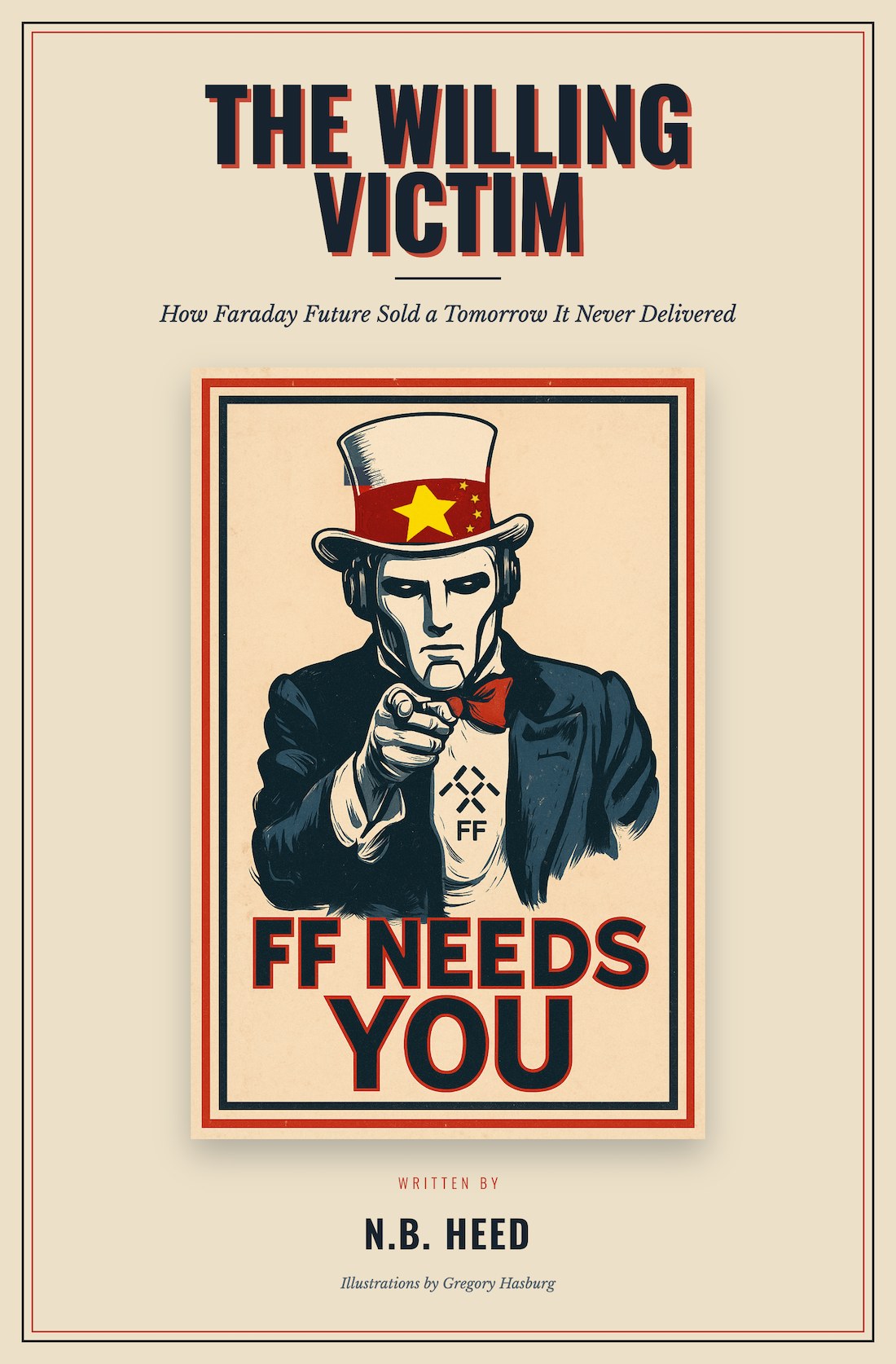
Willing
Victim
it never delivered
“The fiction was written to be read. The truth was written to be filed. That asymmetry is the entire machine.”
The True Story
The decade of Faraday Future and Jia Yueting
The Willing Victim is a narrative account of Faraday Future Intelligent Electric Inc. (Nasdaq: FFAI, formerly FFIE) and its founder, Jia Yueting — the electric-vehicle company that went public in 2021, spent roughly $5 billion, delivered almost nothing (by its own 2025 filings, just four vehicles that year), and reinvented itself again and again: from a luxury car to a cheaper minivan brand, to crypto, to humanoid robots, even proposing to drop “electric vehicle” from its own name.
Every claim in the book is drawn from the public record — Faraday Future’s own SEC filings, its press releases and investor updates, the statements of Jia Yueting and other officers, court rulings, and published reporting. The book makes no accusation of a crime: Faraday Future has not been charged with one, and the SEC enforcement matter that issued a Wells Notice in 2025 was closed without action in 2026. It holds its conclusions exactly where the evidence leaves them — unresolved.
The Machine, in Real Time
Watch the flywheel turn
Convert, sell, sink, split. The book names the mechanism; these counters track it from Faraday Future’s own public filings.
The book, happening while you read it.
The Story
Two documents. Same company. Same day.
One tells the truth — plainly, completely, exactly where the law requires it to go. The other tells a better story, in the place the public actually looks. Both are public. Both go out under the same name. Every time, the reassuring one is the one that travels.
The Willing Victim is not a story about a lie. Nothing here was hidden — that is the whole unsettling point. It is a story about the gap between disclosing the truth and being understood to have disclosed it, and how wide that gap turns out to be: wide enough to run a company through for more than ten years. Told as a nine-rule handbook, assembled from the target’s own paperwork, it ends on the only question left standing: which page are you going to read?
You’ve seen the method. Now hear the whole story.
The Willing Victim · 3h 23m · narrated by Spire Fred
The Handbook
Nine rules. Each one is in the filings.
Read one way, it’s a curtain pulled back. Read the other way, it’s a set of instructions — the playbook for running a public company as a narrative, drawn entirely from the longest-running example the markets have produced.
Start With a Man, Not a Product
You don’t need a product. You need a narrator the crowd will follow past the point where the evidence says stop.
Get Public Before Anyone Checks
Find the door onto the public markets that lets you sell the future and skips most of the checking.
Never Ship. Always Announce.
A shipped product can fail. An announced one lives safely in the future — so keep the announcements coming.
Give Them a Reason to Believe, and an Enemy to Blame
A reason to believe, an enemy for the falling price, a jackpot to dream on. Turn shareholders into partisans.
Tell Them Everything. Make Sure They Don’t Read It.
The move the whole book turns on: disclose the whole truth, on schedule — where no one will ever look.
Sell Stock, Not Cars
Stop pretending the business was ever the product. The raises were the product. Read the cap table, not the income statement.
Build a Maze, Then Live in the Middle of It
Route the value toward the inside through too many turns to follow. The complexity itself is the protection.
When the Regulator Comes, Outlast It
You can’t beat it head-on. So you cooperate, wait it out — and announce the silence as vindication.
Know How It Ends, and Change Your Name Before It Does
The machine can’t run forever. The survivors see the end coming — and shed the name that carries the history.
Where to Listen
Press play on the whole machine.
The full audiobook, narrated by Spire Fred. Start listening today.
Listen now →Hear the Handbook chapter — the introduction that sets up all nine rules.
Watch the preview →A preview of the book, in Chinese. 中文版免费预览。
观看中文预览 (Watch in Chinese) →Also in review for additional audiobook platforms — more listening options are on the way.
Questions
Frequently asked
What is The Willing Victim about?+
It’s a nonfiction audiobook about how a modern public company can tell investors the whole truth — in the filings the law requires — while selling the opposite, warmer story in the press releases the public actually reads, and run that gap for more than a decade, entirely within the law. It lays the method out as a nine-rule handbook, using the longest-running real example the markets have produced.
Is it fiction or nonfiction?+
Nonfiction. It’s built almost entirely from the public record — the company’s own SEC filings, its press releases and investor updates, the statements of its officers, court rulings, and the reporting of others. It relies on documents anyone can pull up, not leaks or anonymous sources.
Who is it about?+
Its central example is the electric-vehicle company Faraday Future and its founder, Jia Yueting. The book stays in a careful, conditional voice: it does not accuse anyone of a crime — the company has not been charged with one — and it leaves the largest questions exactly where the evidence leaves them: unresolved.
Is this the Faraday Future (FFAI) book?+
Yes. The Willing Victim is a full-length nonfiction audiobook about Faraday Future (Nasdaq: FFAI, formerly FFIE) and its founder Jia Yueting, tracing the company’s decade on the public markets — the SPAC listing, the reverse splits, the convertible-note financing, the pivots from cars to crypto to robots — entirely from public filings and reporting.
Did Faraday Future or Jia Yueting commit fraud?+
The book makes no such claim. Faraday Future has not been charged with a crime; an SEC enforcement investigation that issued a Wells Notice in 2025 was closed without action in 2026. The book stays in a careful, conditional voice and does not accuse anyone of wrongdoing — its subject is the gap between what a company legally discloses and what its investors actually understand.
Where can I listen?+
The audiobook is available now on ElevenLabs, Spotify, and Rakuten Kobo, narrated by Spire Fred, with Google Play Books coming soon. A free preview of the Handbook chapter is on the book’s YouTube channel.
What does “the willing victim” mean?+
The willing victim is not someone who was lied to and kept in the dark. He was handed the truth — the going-concern warnings, the dilution, the risk factors, all public — and offered a better story beside it, and he reached for the story. Willing not because he agreed to be harmed, but because he was told, and chose the headline over the document.
The truth was on page forty-one. It was always on page forty-one.
Which page are you going to read?